

Jason
November 16, 2026
If your supplier list doesn't have UPCs, finding the matching Amazon listings gets hard fast. Maybe it's a distributor catalog with only internal SKUs, a supplier who won't share barcodes, or a list where the codes are missing or incomplete.
When there's no code to scan, the usual fallback is manual. You or a VA search Amazon by product title, one item at a time. It's slow, and nobody can search a thousand products carefully without getting tired.
So we ran a test: experienced human scanners against the AI engine that now powers AI Title Search in Analyzer.Tools. Same product lists, same goal: find every Amazon listing that's an exact match.
The AI found 2–3x more matching listings.
2–3x
more exact matches found
18% vs. 12%
average margin opportunity
$2 vs. $233
to search 1,000 products
The setup: human scanners vs. AI
We took real supplier lists, thousands of products long, and asked each side to find the matching Amazon listings.
Team Human: experienced in-house scanners
- Experts at Amazon product scanning
- 2 minutes per SKU, a standard efficient scanning pace
Team AI: the engine behind AI Title Search
- Reads the product title and description and writes its own Amazon search queries, the way a person would
- Reviews the results and keeps searching until it has enough candidates
- Uses an AI model trained specifically to decide whether two listings are the exact same product
Why 2 minutes per SKU? Because that's already a big time investment. At that pace, a typical 1,000-SKU supplier list takes about 33 hours, almost a full work week. Few sellers or VA teams spend more than that on a single list.
The results: two face-offs
We ran two trials. First against our own expert scanners, then against a real seller who had already searched their list by hand.
| Trial | Human result | AI result |
|---|---|---|
| AI vs. expert scanners (2 min/SKU) | Baseline | 2–3x more verified matches |
| AI vs. a seller's own manual search (no time limit) | 0–2 Amazon listings per SKU | More than 2x the listing options |
| Average margin opportunity, same seller | 12% | 18% |
Face-off 1: AI vs. expert scanners
Our experts worked at 2 minutes per SKU. When they were done, a separate quality-check team reviewed every match from both sides for accuracy. After that review, the AI had found 2–3x more real matches.
Face-off 2: AI vs. a real seller
Next we used a client's list. They source directly from a division of Procter & Gamble and hired us to help manage their Amazon catalog. Before they had AI search, they had searched the list themselves with no time limit and found 0 to 2 listings per SKU.
The AI scanned the same list and returned more than twice as many options.
The part that matters: margin
More listings means more chances to find a profitable one. On the seller's own manual results, the average margin opportunity at current Amazon prices was 12%. On the listings the AI found, it was 18%.
With twice the options and better margins, that's potentially more than double the profit from the same supplier list, if you have the capital to buy into it.
The cost: $233 vs. $2 per 1,000 products
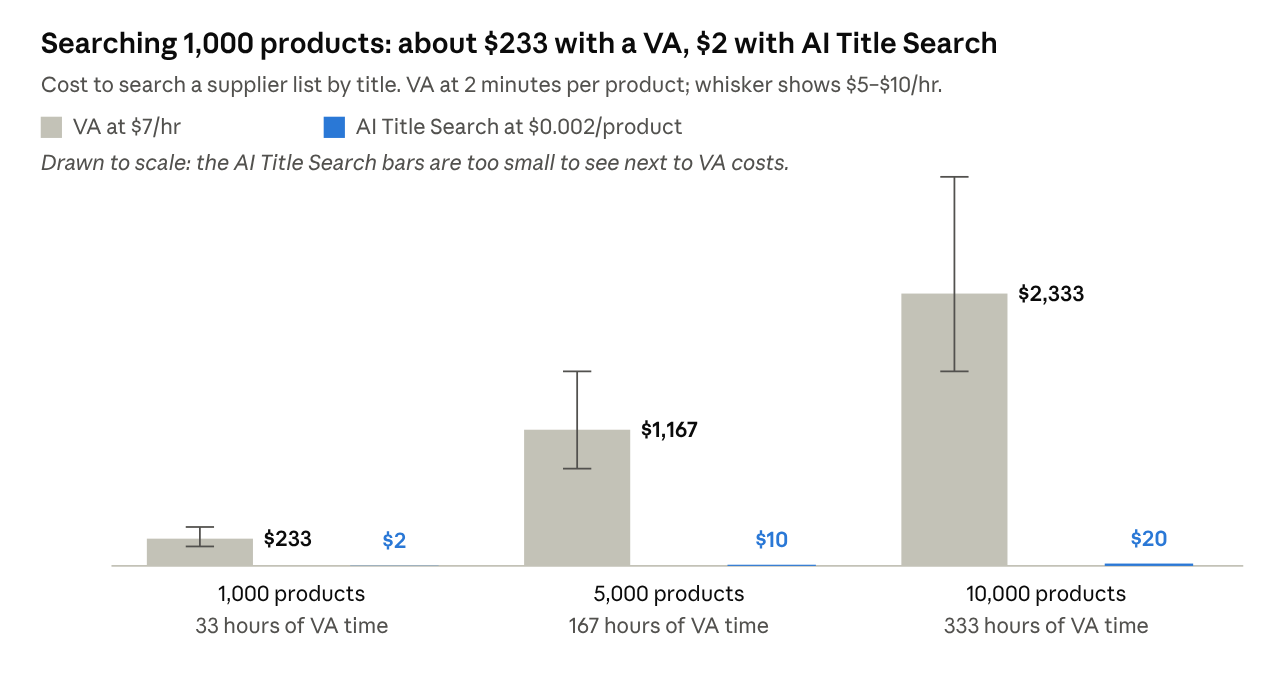
Better results would be reason enough. But the cost gap is even bigger: searching 1,000 products by hand takes about 33 hours, or $233 in VA time. AI Title Search does it for $2.
How we worked it out:
- VA rate: $7/hour. Overseas Amazon sourcing VAs typically charge $5–$10/hour. Sourcing VA job posts list $5–$9/hour, and dedicated Filipino Amazon VAs run $6.50–$10/hour.
- VA time: 2 minutes per product, the same pace our expert scanners used in the trial.
- AI Title Search: $0.002 per product.
At 10,000 products, that VA time adds up to about two months of full-time work.
And that's the generous version of the VA math. It doesn't count hiring, training, or checking a VA's work. The AI also found 2–3x more matches, so per listing found, AI Title Search costs more than 200 times less.
What this means for your sourcing
If your list has UPCs, start with a UPC scan. It's the fastest and most accurate way to match products to Amazon listings, and nothing beats it when the codes are there.
AI Title Search is for the products a UPC scan can't run on:
- Supplier lists with no UPCs, only product titles or internal SKUs
- Lists where codes are missing, partial, or unusable
- Suppliers who don't share barcodes at all
Until now, those products meant hours of manual searching, a "keyword search" tool that rarely found the right listing, or skipping them entirely. AI Title Search does what a VA would do, searching Amazon by title and description, but it doesn't get tired, and it filters out listings that aren't an exact match.
Why "keyword search" tools never worked
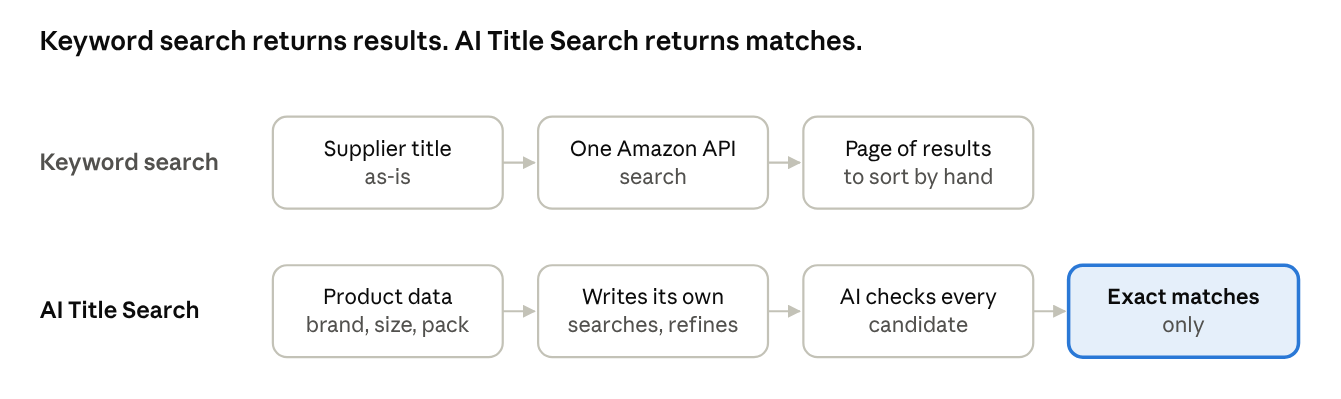
Some sourcing tools already offer a keyword or title search. Under the hood, most of them just pass your product title to Amazon's API and return whatever comes back.
The problem is that Amazon's API is poor at keyword and title searches. Supplier titles rarely match how a product is listed on Amazon. Brand names get abbreviated, sizes are written differently, and the listing you want is often buried under sponsored and "similar" results. One query, one set of results, no judgment about whether any of them is actually the same product. That's why these features have never been reliable, especially when you run a whole list in bulk.
AI Title Search is a different kind of tool
AI Title Search is the first of its kind: a purpose-built AI engine designed to match products, not just search for them. For each product on your list, it:
- Reads the product data and works out what actually identifies it: brand, model, size, count, variant.
- Writes its own search queries, the way an experienced sourcer would, and keeps refining them until it has strong candidates.
- Reviews every candidate with an AI model trained on hundreds of thousands of real product pairs to tell an exact match from a lookalike.
- Filters out non-matches, so what you get back are listings worth checking, not a page of keyword results.
That's the difference between a search box and a sourcing engine, and it's why it holds up on a 1,000-product list, not just a single lookup.
The workflow:
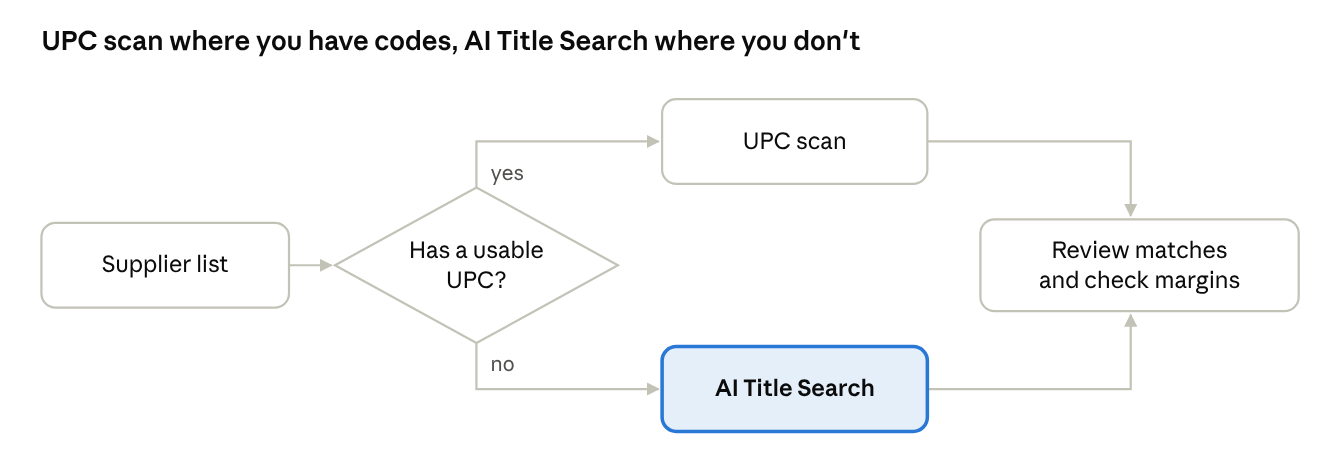
- Scan everything that has a UPC. Fast, accurate, and the foundation of your sourcing.
- Run AI Title Search on the products without usable codes. No more hand-searching or skipping them.
- Review the matches and check margins. Most sellers skip products without codes, so those listings often have less competition.
Run the test on your own list
The easiest way to see the difference is to take the products on your list that don't have UPCs and run them through AI Title Search in Analyzer.Tools. Compare the results against what you or your VA would find searching by hand. New to it? Here's how to bulk search Amazon using product titles.
Gone are the days of paying a VA team to search a product list by hand, one listing at a time. Let the AI do the searching, and spend your time on the buying decisions.
FAQ
How do I find a product on Amazon without a UPC?
Search by the product's title and details: brand, model, size, and pack count. You can do it by hand one product at a time, or run the whole list through AI Title Search, which writes the searches for you and filters out listings that aren't an exact match.
How do I scout bulk wholesale lists quickly?
Split the list in two. Run every product with a UPC through a bulk UPC scan, then run the rest through AI Title Search. Together they cover the whole list in minutes instead of days. For the bigger picture, see our guide to selling wholesale on Amazon.
Is an Amazon sourcing VA worth it for searching supplier lists?
A VA is great for judgment calls, but searching lists by title is slow, repetitive work. At typical overseas rates, a VA costs about $233 to search 1,000 products. AI Title Search does it for $2, or free with the tokens included in your Web App plan, and found 2–3x more matches in our trials.
Does AI Title Search replace UPC scanning?
No. When you have UPCs, a UPC scan is the fastest and most accurate option. AI Title Search covers the products a UPC scan can't: lists with no codes, missing codes, or codes that don't match.